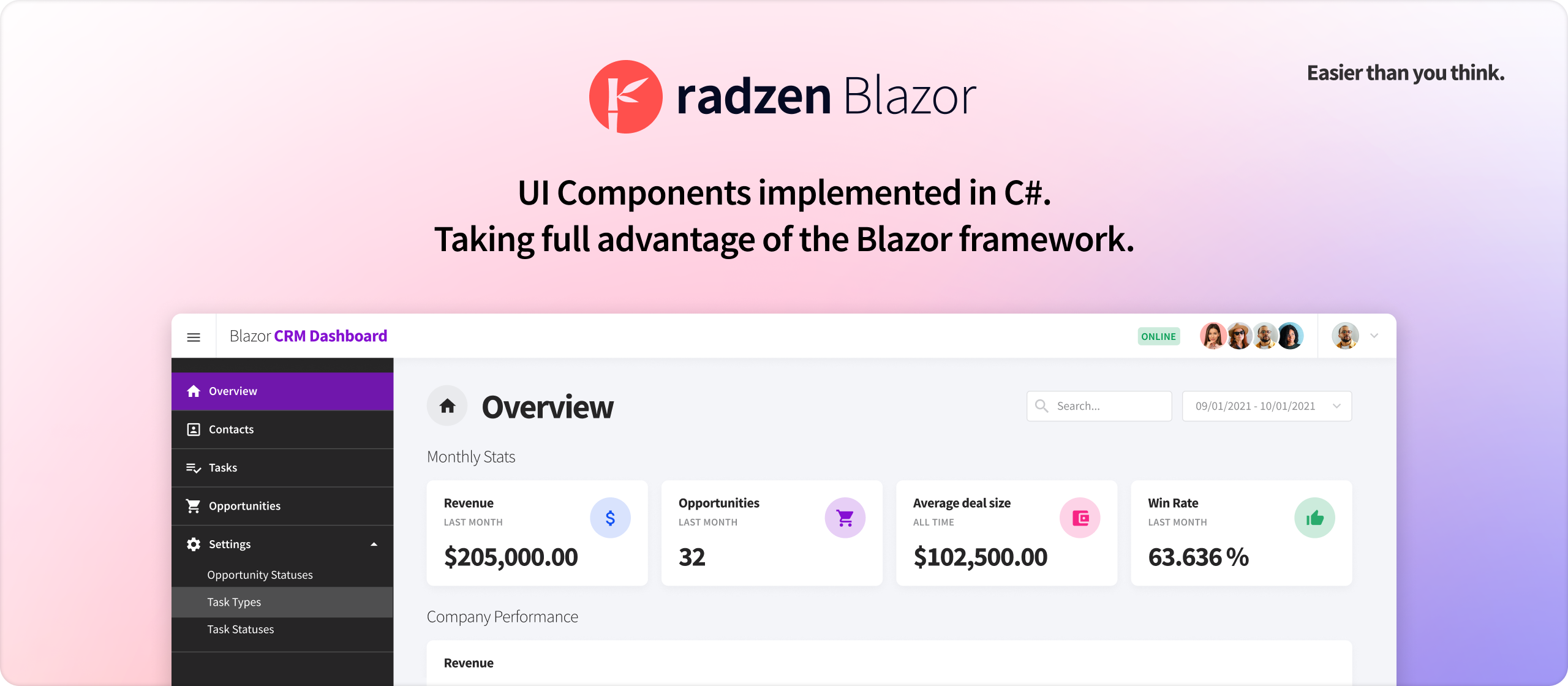
Radzen Blazor is the most sophisticated free UI component library for Blazor, featuring 145+ native components including DataGrid, Scheduler, Charts, and advanced theming with full support for Material Design and Fluent UI. If Radzen Blazor is useful to you, a ⭐ on GitHub helps other Blazor developers find it. https://blazor.radzen.com
  • C# 67%
  • HTML 24.3%
  • SCSS 6.3%
  • JavaScript 2.3%
Find a file
Repository files (latest commit first)
Filename Latest commit message Latest commit date
Vladimir Enchev 1f00480b65 version updated
2026-11-20 10:09:03 +02:00
.github .NET 11 support added and .NET 8 support removed. Radzen.Blazor now targets net9.0, net10.0 and net11.0 with 11.*-* Components references, and the Sass, MoveCss and MinifyJs targets key on net11.0; the test, demo, API, tools and trimming projects, the Dockerfile images, the CI, deploy and NuGet workflows and the e2e docs moved to net11.0. The always-true NET6_0_OR_GREATER and NET8_0_OR_GREATER conditionals were collapsed. EditContext.Validate is obsolete in .NET 11, so RadzenTemplateForm, RadzenSteps and RadzenDataGrid.UpdateRow await ValidateAsync on net11.0, and the demo host dropped the obsolete UseWebAssemblyDebugging call with its inspectUri launch entries. The new .NET 11 analyzers are fixed rather than suppressed: CA1307 call sites pass StringComparison.Ordinal with the net11-only char overloads polyfilled for net9 and net10 in StringComparisonExtensions, CA1860 Any() calls compare Count or Length, CA2263 uses a GetJsonTypeInfo<T> helper that takes the generic GetTypeInfo overload on net11, and BL0012 removed seventeen StateHasChanged calls from private event handlers that ComponentBase already renders after. BL0016 (unguarded JS interop) stays in NoWarn because it accepts only a try/catch around each of 272 interop calls. The tests moved to bUnit 2.13.3, which drives the .NET 11 Virtualize component natively, behind a compatibility layer so the test sources stay as they are on master: Radzen.Blazor.Tests.TestContext derives from BunitContext and keeps RenderComponent, the ComponentParameter.CreateParameter overload and a synchronous DisposeComponents, extension methods keep SetParametersAndRender and ToMarkup, and global using aliases map TestContext, ComponentParameter and IRenderedFragment for every test namespace, so tests written against either bUnit version compile unchanged and merges from master carry no test churn. The real .NET 11 changes in the tests are a handful: EditContext.Validate is obsolete so the DataAnnotationValidator tests await ValidateAsync, AIChatService.TryQueueMessageAsync became virtual so the fake overrides it, xunit moved to 2.4.2 and its NotNull annotations make two Assert.Equal(float, float, int) calls name the precision argument and two Markdown update asserts check for null first, and CS8632 is silenced in the project because the annotations in test files without a nullable context are harmless. The chart tick label expectation follows the exact double-to-decimal conversion in .NET 11. Verified with the full suite on net11.0, the trimmed runtime gate and Playwright against the demo app for the components whose StateHasChanged calls were removed. 2026-11-09 14:16:17 +02:00
e2e .NET 11 support added and .NET 8 support removed. Radzen.Blazor now targets net9.0, net10.0 and net11.0 with 11.*-* Components references, and the Sass, MoveCss and MinifyJs targets key on net11.0; the test, demo, API, tools and trimming projects, the Dockerfile images, the CI, deploy and NuGet workflows and the e2e docs moved to net11.0. The always-true NET6_0_OR_GREATER and NET8_0_OR_GREATER conditionals were collapsed. EditContext.Validate is obsolete in .NET 11, so RadzenTemplateForm, RadzenSteps and RadzenDataGrid.UpdateRow await ValidateAsync on net11.0, and the demo host dropped the obsolete UseWebAssemblyDebugging call with its inspectUri launch entries. The new .NET 11 analyzers are fixed rather than suppressed: CA1307 call sites pass StringComparison.Ordinal with the net11-only char overloads polyfilled for net9 and net10 in StringComparisonExtensions, CA1860 Any() calls compare Count or Length, CA2263 uses a GetJsonTypeInfo<T> helper that takes the generic GetTypeInfo overload on net11, and BL0012 removed seventeen StateHasChanged calls from private event handlers that ComponentBase already renders after. BL0016 (unguarded JS interop) stays in NoWarn because it accepts only a try/catch around each of 272 interop calls. The tests moved to bUnit 2.13.3, which drives the .NET 11 Virtualize component natively, behind a compatibility layer so the test sources stay as they are on master: Radzen.Blazor.Tests.TestContext derives from BunitContext and keeps RenderComponent, the ComponentParameter.CreateParameter overload and a synchronous DisposeComponents, extension methods keep SetParametersAndRender and ToMarkup, and global using aliases map TestContext, ComponentParameter and IRenderedFragment for every test namespace, so tests written against either bUnit version compile unchanged and merges from master carry no test churn. The real .NET 11 changes in the tests are a handful: EditContext.Validate is obsolete so the DataAnnotationValidator tests await ValidateAsync, AIChatService.TryQueueMessageAsync became virtual so the fake overrides it, xunit moved to 2.4.2 and its NotNull annotations make two Assert.Equal(float, float, int) calls name the precision argument and two Markdown update asserts check for null first, and CS8632 is silenced in the project because the annotations in test files without a nullable context are harmless. The chart tick label expectation follows the exact double-to-decimal conversion in .NET 11. Verified with the full suite on net11.0, the trimmed runtime gate and Playwright against the demo app for the components whose StateHasChanged calls were removed. 2026-11-09 14:16:17 +02:00
Radzen.Blazor version updated 2026-11-20 10:09:03 +02:00
Radzen.Blazor.Api .NET 11 support added and .NET 8 support removed. Radzen.Blazor now targets net9.0, net10.0 and net11.0 with 11.*-* Components references, and the Sass, MoveCss and MinifyJs targets key on net11.0; the test, demo, API, tools and trimming projects, the Dockerfile images, the CI, deploy and NuGet workflows and the e2e docs moved to net11.0. The always-true NET6_0_OR_GREATER and NET8_0_OR_GREATER conditionals were collapsed. EditContext.Validate is obsolete in .NET 11, so RadzenTemplateForm, RadzenSteps and RadzenDataGrid.UpdateRow await ValidateAsync on net11.0, and the demo host dropped the obsolete UseWebAssemblyDebugging call with its inspectUri launch entries. The new .NET 11 analyzers are fixed rather than suppressed: CA1307 call sites pass StringComparison.Ordinal with the net11-only char overloads polyfilled for net9 and net10 in StringComparisonExtensions, CA1860 Any() calls compare Count or Length, CA2263 uses a GetJsonTypeInfo<T> helper that takes the generic GetTypeInfo overload on net11, and BL0012 removed seventeen StateHasChanged calls from private event handlers that ComponentBase already renders after. BL0016 (unguarded JS interop) stays in NoWarn because it accepts only a try/catch around each of 272 interop calls. The tests moved to bUnit 2.13.3, which drives the .NET 11 Virtualize component natively, behind a compatibility layer so the test sources stay as they are on master: Radzen.Blazor.Tests.TestContext derives from BunitContext and keeps RenderComponent, the ComponentParameter.CreateParameter overload and a synchronous DisposeComponents, extension methods keep SetParametersAndRender and ToMarkup, and global using aliases map TestContext, ComponentParameter and IRenderedFragment for every test namespace, so tests written against either bUnit version compile unchanged and merges from master carry no test churn. The real .NET 11 changes in the tests are a handful: EditContext.Validate is obsolete so the DataAnnotationValidator tests await ValidateAsync, AIChatService.TryQueueMessageAsync became virtual so the fake overrides it, xunit moved to 2.4.2 and its NotNull annotations make two Assert.Equal(float, float, int) calls name the precision argument and two Markdown update asserts check for null first, and CS8632 is silenced in the project because the annotations in test files without a nullable context are harmless. The chart tick label expectation follows the exact double-to-decimal conversion in .NET 11. Verified with the full suite on net11.0, the trimmed runtime gate and Playwright against the demo app for the components whose StateHasChanged calls were removed. 2026-11-09 14:16:17 +02:00
Radzen.Blazor.Api.Generator .NET 11 support added and .NET 8 support removed. Radzen.Blazor now targets net9.0, net10.0 and net11.0 with 11.*-* Components references, and the Sass, MoveCss and MinifyJs targets key on net11.0; the test, demo, API, tools and trimming projects, the Dockerfile images, the CI, deploy and NuGet workflows and the e2e docs moved to net11.0. The always-true NET6_0_OR_GREATER and NET8_0_OR_GREATER conditionals were collapsed. EditContext.Validate is obsolete in .NET 11, so RadzenTemplateForm, RadzenSteps and RadzenDataGrid.UpdateRow await ValidateAsync on net11.0, and the demo host dropped the obsolete UseWebAssemblyDebugging call with its inspectUri launch entries. The new .NET 11 analyzers are fixed rather than suppressed: CA1307 call sites pass StringComparison.Ordinal with the net11-only char overloads polyfilled for net9 and net10 in StringComparisonExtensions, CA1860 Any() calls compare Count or Length, CA2263 uses a GetJsonTypeInfo<T> helper that takes the generic GetTypeInfo overload on net11, and BL0012 removed seventeen StateHasChanged calls from private event handlers that ComponentBase already renders after. BL0016 (unguarded JS interop) stays in NoWarn because it accepts only a try/catch around each of 272 interop calls. The tests moved to bUnit 2.13.3, which drives the .NET 11 Virtualize component natively, behind a compatibility layer so the test sources stay as they are on master: Radzen.Blazor.Tests.TestContext derives from BunitContext and keeps RenderComponent, the ComponentParameter.CreateParameter overload and a synchronous DisposeComponents, extension methods keep SetParametersAndRender and ToMarkup, and global using aliases map TestContext, ComponentParameter and IRenderedFragment for every test namespace, so tests written against either bUnit version compile unchanged and merges from master carry no test churn. The real .NET 11 changes in the tests are a handful: EditContext.Validate is obsolete so the DataAnnotationValidator tests await ValidateAsync, AIChatService.TryQueueMessageAsync became virtual so the fake overrides it, xunit moved to 2.4.2 and its NotNull annotations make two Assert.Equal(float, float, int) calls name the precision argument and two Markdown update asserts check for null first, and CS8632 is silenced in the project because the annotations in test files without a nullable context are harmless. The chart tick label expectation follows the exact double-to-decimal conversion in .NET 11. Verified with the full suite on net11.0, the trimmed runtime gate and Playwright against the demo app for the components whose StateHasChanged calls were removed. 2026-11-09 14:16:17 +02:00
Radzen.Blazor.Tests Chart axis, data label and range navigator tick formatting and gauge scale and pointer formatting use the component's Culture, falling back to the current culture, so a chart or gauge with its own Culture formats FormatString values and default labels with it 2026-11-20 09:31:23 +02:00
Radzen.Blazor.TrimRuntimeTest .NET 11 support added and .NET 8 support removed. Radzen.Blazor now targets net9.0, net10.0 and net11.0 with 11.*-* Components references, and the Sass, MoveCss and MinifyJs targets key on net11.0; the test, demo, API, tools and trimming projects, the Dockerfile images, the CI, deploy and NuGet workflows and the e2e docs moved to net11.0. The always-true NET6_0_OR_GREATER and NET8_0_OR_GREATER conditionals were collapsed. EditContext.Validate is obsolete in .NET 11, so RadzenTemplateForm, RadzenSteps and RadzenDataGrid.UpdateRow await ValidateAsync on net11.0, and the demo host dropped the obsolete UseWebAssemblyDebugging call with its inspectUri launch entries. The new .NET 11 analyzers are fixed rather than suppressed: CA1307 call sites pass StringComparison.Ordinal with the net11-only char overloads polyfilled for net9 and net10 in StringComparisonExtensions, CA1860 Any() calls compare Count or Length, CA2263 uses a GetJsonTypeInfo<T> helper that takes the generic GetTypeInfo overload on net11, and BL0012 removed seventeen StateHasChanged calls from private event handlers that ComponentBase already renders after. BL0016 (unguarded JS interop) stays in NoWarn because it accepts only a try/catch around each of 272 interop calls. The tests moved to bUnit 2.13.3, which drives the .NET 11 Virtualize component natively, behind a compatibility layer so the test sources stay as they are on master: Radzen.Blazor.Tests.TestContext derives from BunitContext and keeps RenderComponent, the ComponentParameter.CreateParameter overload and a synchronous DisposeComponents, extension methods keep SetParametersAndRender and ToMarkup, and global using aliases map TestContext, ComponentParameter and IRenderedFragment for every test namespace, so tests written against either bUnit version compile unchanged and merges from master carry no test churn. The real .NET 11 changes in the tests are a handful: EditContext.Validate is obsolete so the DataAnnotationValidator tests await ValidateAsync, AIChatService.TryQueueMessageAsync became virtual so the fake overrides it, xunit moved to 2.4.2 and its NotNull annotations make two Assert.Equal(float, float, int) calls name the precision argument and two Markdown update asserts check for null first, and CS8632 is silenced in the project because the annotations in test files without a nullable context are harmless. The chart tick label expectation follows the exact double-to-decimal conversion in .NET 11. Verified with the full suite on net11.0, the trimmed runtime gate and Playwright against the demo app for the components whose StateHasChanged calls were removed. 2026-11-09 14:16:17 +02:00
Radzen.Blazor.TrimTest .NET 11 support added and .NET 8 support removed. Radzen.Blazor now targets net9.0, net10.0 and net11.0 with 11.*-* Components references, and the Sass, MoveCss and MinifyJs targets key on net11.0; the test, demo, API, tools and trimming projects, the Dockerfile images, the CI, deploy and NuGet workflows and the e2e docs moved to net11.0. The always-true NET6_0_OR_GREATER and NET8_0_OR_GREATER conditionals were collapsed. EditContext.Validate is obsolete in .NET 11, so RadzenTemplateForm, RadzenSteps and RadzenDataGrid.UpdateRow await ValidateAsync on net11.0, and the demo host dropped the obsolete UseWebAssemblyDebugging call with its inspectUri launch entries. The new .NET 11 analyzers are fixed rather than suppressed: CA1307 call sites pass StringComparison.Ordinal with the net11-only char overloads polyfilled for net9 and net10 in StringComparisonExtensions, CA1860 Any() calls compare Count or Length, CA2263 uses a GetJsonTypeInfo<T> helper that takes the generic GetTypeInfo overload on net11, and BL0012 removed seventeen StateHasChanged calls from private event handlers that ComponentBase already renders after. BL0016 (unguarded JS interop) stays in NoWarn because it accepts only a try/catch around each of 272 interop calls. The tests moved to bUnit 2.13.3, which drives the .NET 11 Virtualize component natively, behind a compatibility layer so the test sources stay as they are on master: Radzen.Blazor.Tests.TestContext derives from BunitContext and keeps RenderComponent, the ComponentParameter.CreateParameter overload and a synchronous DisposeComponents, extension methods keep SetParametersAndRender and ToMarkup, and global using aliases map TestContext, ComponentParameter and IRenderedFragment for every test namespace, so tests written against either bUnit version compile unchanged and merges from master carry no test churn. The real .NET 11 changes in the tests are a handful: EditContext.Validate is obsolete so the DataAnnotationValidator tests await ValidateAsync, AIChatService.TryQueueMessageAsync became virtual so the fake overrides it, xunit moved to 2.4.2 and its NotNull annotations make two Assert.Equal(float, float, int) calls name the precision argument and two Markdown update asserts check for null first, and CS8632 is silenced in the project because the annotations in test files without a nullable context are harmless. The chart tick label expectation follows the exact double-to-decimal conversion in .NET 11. Verified with the full suite on net11.0, the trimmed runtime gate and Playwright against the demo app for the components whose StateHasChanged calls were removed. 2026-11-09 14:16:17 +02:00
Radzen.Blazor.TrimTest.Models .NET 11 support added and .NET 8 support removed. Radzen.Blazor now targets net9.0, net10.0 and net11.0 with 11.*-* Components references, and the Sass, MoveCss and MinifyJs targets key on net11.0; the test, demo, API, tools and trimming projects, the Dockerfile images, the CI, deploy and NuGet workflows and the e2e docs moved to net11.0. The always-true NET6_0_OR_GREATER and NET8_0_OR_GREATER conditionals were collapsed. EditContext.Validate is obsolete in .NET 11, so RadzenTemplateForm, RadzenSteps and RadzenDataGrid.UpdateRow await ValidateAsync on net11.0, and the demo host dropped the obsolete UseWebAssemblyDebugging call with its inspectUri launch entries. The new .NET 11 analyzers are fixed rather than suppressed: CA1307 call sites pass StringComparison.Ordinal with the net11-only char overloads polyfilled for net9 and net10 in StringComparisonExtensions, CA1860 Any() calls compare Count or Length, CA2263 uses a GetJsonTypeInfo<T> helper that takes the generic GetTypeInfo overload on net11, and BL0012 removed seventeen StateHasChanged calls from private event handlers that ComponentBase already renders after. BL0016 (unguarded JS interop) stays in NoWarn because it accepts only a try/catch around each of 272 interop calls. The tests moved to bUnit 2.13.3, which drives the .NET 11 Virtualize component natively, behind a compatibility layer so the test sources stay as they are on master: Radzen.Blazor.Tests.TestContext derives from BunitContext and keeps RenderComponent, the ComponentParameter.CreateParameter overload and a synchronous DisposeComponents, extension methods keep SetParametersAndRender and ToMarkup, and global using aliases map TestContext, ComponentParameter and IRenderedFragment for every test namespace, so tests written against either bUnit version compile unchanged and merges from master carry no test churn. The real .NET 11 changes in the tests are a handful: EditContext.Validate is obsolete so the DataAnnotationValidator tests await ValidateAsync, AIChatService.TryQueueMessageAsync became virtual so the fake overrides it, xunit moved to 2.4.2 and its NotNull annotations make two Assert.Equal(float, float, int) calls name the precision argument and two Markdown update asserts check for null first, and CS8632 is silenced in the project because the annotations in test files without a nullable context are harmless. The chart tick label expectation follows the exact double-to-decimal conversion in .NET 11. Verified with the full suite on net11.0, the trimmed runtime gate and Playwright against the demo app for the components whose StateHasChanged calls were removed. 2026-11-09 14:16:17 +02:00
RadzenBlazorDemos Update premium themes 2026-11-19 16:10:37 +00:00
RadzenBlazorDemos.Host .NET 11 support added and .NET 8 support removed. Radzen.Blazor now targets net9.0, net10.0 and net11.0 with 11.*-* Components references, and the Sass, MoveCss and MinifyJs targets key on net11.0; the test, demo, API, tools and trimming projects, the Dockerfile images, the CI, deploy and NuGet workflows and the e2e docs moved to net11.0. The always-true NET6_0_OR_GREATER and NET8_0_OR_GREATER conditionals were collapsed. EditContext.Validate is obsolete in .NET 11, so RadzenTemplateForm, RadzenSteps and RadzenDataGrid.UpdateRow await ValidateAsync on net11.0, and the demo host dropped the obsolete UseWebAssemblyDebugging call with its inspectUri launch entries. The new .NET 11 analyzers are fixed rather than suppressed: CA1307 call sites pass StringComparison.Ordinal with the net11-only char overloads polyfilled for net9 and net10 in StringComparisonExtensions, CA1860 Any() calls compare Count or Length, CA2263 uses a GetJsonTypeInfo<T> helper that takes the generic GetTypeInfo overload on net11, and BL0012 removed seventeen StateHasChanged calls from private event handlers that ComponentBase already renders after. BL0016 (unguarded JS interop) stays in NoWarn because it accepts only a try/catch around each of 272 interop calls. The tests moved to bUnit 2.13.3, which drives the .NET 11 Virtualize component natively, behind a compatibility layer so the test sources stay as they are on master: Radzen.Blazor.Tests.TestContext derives from BunitContext and keeps RenderComponent, the ComponentParameter.CreateParameter overload and a synchronous DisposeComponents, extension methods keep SetParametersAndRender and ToMarkup, and global using aliases map TestContext, ComponentParameter and IRenderedFragment for every test namespace, so tests written against either bUnit version compile unchanged and merges from master carry no test churn. The real .NET 11 changes in the tests are a handful: EditContext.Validate is obsolete so the DataAnnotationValidator tests await ValidateAsync, AIChatService.TryQueueMessageAsync became virtual so the fake overrides it, xunit moved to 2.4.2 and its NotNull annotations make two Assert.Equal(float, float, int) calls name the precision argument and two Markdown update asserts check for null first, and CS8632 is silenced in the project because the annotations in test files without a nullable context are harmless. The chart tick label expectation follows the exact double-to-decimal conversion in .NET 11. Verified with the full suite on net11.0, the trimmed runtime gate and Playwright against the demo app for the components whose StateHasChanged calls were removed. 2026-11-09 14:16:17 +02:00
RadzenBlazorDemos.Server .NET 11 support added and .NET 8 support removed. Radzen.Blazor now targets net9.0, net10.0 and net11.0 with 11.*-* Components references, and the Sass, MoveCss and MinifyJs targets key on net11.0; the test, demo, API, tools and trimming projects, the Dockerfile images, the CI, deploy and NuGet workflows and the e2e docs moved to net11.0. The always-true NET6_0_OR_GREATER and NET8_0_OR_GREATER conditionals were collapsed. EditContext.Validate is obsolete in .NET 11, so RadzenTemplateForm, RadzenSteps and RadzenDataGrid.UpdateRow await ValidateAsync on net11.0, and the demo host dropped the obsolete UseWebAssemblyDebugging call with its inspectUri launch entries. The new .NET 11 analyzers are fixed rather than suppressed: CA1307 call sites pass StringComparison.Ordinal with the net11-only char overloads polyfilled for net9 and net10 in StringComparisonExtensions, CA1860 Any() calls compare Count or Length, CA2263 uses a GetJsonTypeInfo<T> helper that takes the generic GetTypeInfo overload on net11, and BL0012 removed seventeen StateHasChanged calls from private event handlers that ComponentBase already renders after. BL0016 (unguarded JS interop) stays in NoWarn because it accepts only a try/catch around each of 272 interop calls. The tests moved to bUnit 2.13.3, which drives the .NET 11 Virtualize component natively, behind a compatibility layer so the test sources stay as they are on master: Radzen.Blazor.Tests.TestContext derives from BunitContext and keeps RenderComponent, the ComponentParameter.CreateParameter overload and a synchronous DisposeComponents, extension methods keep SetParametersAndRender and ToMarkup, and global using aliases map TestContext, ComponentParameter and IRenderedFragment for every test namespace, so tests written against either bUnit version compile unchanged and merges from master carry no test churn. The real .NET 11 changes in the tests are a handful: EditContext.Validate is obsolete so the DataAnnotationValidator tests await ValidateAsync, AIChatService.TryQueueMessageAsync became virtual so the fake overrides it, xunit moved to 2.4.2 and its NotNull annotations make two Assert.Equal(float, float, int) calls name the precision argument and two Markdown update asserts check for null first, and CS8632 is silenced in the project because the annotations in test files without a nullable context are harmless. The chart tick label expectation follows the exact double-to-decimal conversion in .NET 11. Verified with the full suite on net11.0, the trimmed runtime gate and Playwright against the demo app for the components whose StateHasChanged calls were removed. 2026-11-09 14:16:17 +02:00
RadzenBlazorDemos.Tools .NET 11 support added and .NET 8 support removed. Radzen.Blazor now targets net9.0, net10.0 and net11.0 with 11.*-* Components references, and the Sass, MoveCss and MinifyJs targets key on net11.0; the test, demo, API, tools and trimming projects, the Dockerfile images, the CI, deploy and NuGet workflows and the e2e docs moved to net11.0. The always-true NET6_0_OR_GREATER and NET8_0_OR_GREATER conditionals were collapsed. EditContext.Validate is obsolete in .NET 11, so RadzenTemplateForm, RadzenSteps and RadzenDataGrid.UpdateRow await ValidateAsync on net11.0, and the demo host dropped the obsolete UseWebAssemblyDebugging call with its inspectUri launch entries. The new .NET 11 analyzers are fixed rather than suppressed: CA1307 call sites pass StringComparison.Ordinal with the net11-only char overloads polyfilled for net9 and net10 in StringComparisonExtensions, CA1860 Any() calls compare Count or Length, CA2263 uses a GetJsonTypeInfo<T> helper that takes the generic GetTypeInfo overload on net11, and BL0012 removed seventeen StateHasChanged calls from private event handlers that ComponentBase already renders after. BL0016 (unguarded JS interop) stays in NoWarn because it accepts only a try/catch around each of 272 interop calls. The tests moved to bUnit 2.13.3, which drives the .NET 11 Virtualize component natively, behind a compatibility layer so the test sources stay as they are on master: Radzen.Blazor.Tests.TestContext derives from BunitContext and keeps RenderComponent, the ComponentParameter.CreateParameter overload and a synchronous DisposeComponents, extension methods keep SetParametersAndRender and ToMarkup, and global using aliases map TestContext, ComponentParameter and IRenderedFragment for every test namespace, so tests written against either bUnit version compile unchanged and merges from master carry no test churn. The real .NET 11 changes in the tests are a handful: EditContext.Validate is obsolete so the DataAnnotationValidator tests await ValidateAsync, AIChatService.TryQueueMessageAsync became virtual so the fake overrides it, xunit moved to 2.4.2 and its NotNull annotations make two Assert.Equal(float, float, int) calls name the precision argument and two Markdown update asserts check for null first, and CS8632 is silenced in the project because the annotations in test files without a nullable context are harmless. The chart tick label expectation follows the exact double-to-decimal conversion in .NET 11. Verified with the full suite on net11.0, the trimmed runtime gate and Playwright against the demo app for the components whose StateHasChanged calls were removed. 2026-11-09 14:16:17 +02:00
.dockerignore The blazor.radzen.com sitemap carries lastmod dates again. The sitemap generator takes each page's date from git log, but the deploy checked out with fetch-depth 1 and .dockerignore kept .git out of the build context, so the Release publish inside Docker found no repository and wrote 364 URLs without lastmod (and a shallow history would have dated every page to the deploy commit). The checkout now fetches full history and .git is part of the build context; it stays in the build stage, since the runtime stage copies only /app/out. With history, 362 of the 364 URLs get the date of their page's last commit. 2026-10-12 17:12:03 +03:00
.gitignore Stop ignoring loose *.md files 2026-09-15 09:38:33 +03:00
context7.json Add context7.json to claim the library on Context7 2026-11-03 16:00:01 +02:00
CONTRIBUTING.md Fix dead byzanz link in CONTRIBUTING.md 2026-11-18 05:37:11 +05:30
Directory.Build.props Stop embedding sources/PDB in shipped WASM assemblies 2026-06-22 13:17:34 +03:00
Dockerfile .NET 11 support added and .NET 8 support removed. Radzen.Blazor now targets net9.0, net10.0 and net11.0 with 11.*-* Components references, and the Sass, MoveCss and MinifyJs targets key on net11.0; the test, demo, API, tools and trimming projects, the Dockerfile images, the CI, deploy and NuGet workflows and the e2e docs moved to net11.0. The always-true NET6_0_OR_GREATER and NET8_0_OR_GREATER conditionals were collapsed. EditContext.Validate is obsolete in .NET 11, so RadzenTemplateForm, RadzenSteps and RadzenDataGrid.UpdateRow await ValidateAsync on net11.0, and the demo host dropped the obsolete UseWebAssemblyDebugging call with its inspectUri launch entries. The new .NET 11 analyzers are fixed rather than suppressed: CA1307 call sites pass StringComparison.Ordinal with the net11-only char overloads polyfilled for net9 and net10 in StringComparisonExtensions, CA1860 Any() calls compare Count or Length, CA2263 uses a GetJsonTypeInfo<T> helper that takes the generic GetTypeInfo overload on net11, and BL0012 removed seventeen StateHasChanged calls from private event handlers that ComponentBase already renders after. BL0016 (unguarded JS interop) stays in NoWarn because it accepts only a try/catch around each of 272 interop calls. The tests moved to bUnit 2.13.3, which drives the .NET 11 Virtualize component natively, behind a compatibility layer so the test sources stay as they are on master: Radzen.Blazor.Tests.TestContext derives from BunitContext and keeps RenderComponent, the ComponentParameter.CreateParameter overload and a synchronous DisposeComponents, extension methods keep SetParametersAndRender and ToMarkup, and global using aliases map TestContext, ComponentParameter and IRenderedFragment for every test namespace, so tests written against either bUnit version compile unchanged and merges from master carry no test churn. The real .NET 11 changes in the tests are a handful: EditContext.Validate is obsolete so the DataAnnotationValidator tests await ValidateAsync, AIChatService.TryQueueMessageAsync became virtual so the fake overrides it, xunit moved to 2.4.2 and its NotNull annotations make two Assert.Equal(float, float, int) calls name the precision argument and two Markdown update asserts check for null first, and CS8632 is silenced in the project because the annotations in test files without a nullable context are harmless. The chart tick label expectation follows the exact double-to-decimal conversion in .NET 11. Verified with the full suite on net11.0, the trimmed runtime gate and Playwright against the demo app for the components whose StateHasChanged calls were removed. 2026-11-09 14:16:17 +02:00
getting-started.md Version 13.0.0 with the .NET 8 removal recorded and RadzenDataGrid.IsValidAsync added. Dropping net8.0 is a breaking change, so the package version moves from 12.2.0 to 13.0.0 and the changelog page gets a v13 section with the breaking entry and a .NET 11 section. RadzenDataGrid.IsValid calls the synchronous EditContext.Validate, which on .NET 11 throws InvalidOperationException when a validator of an edited row registers asynchronous work, while UpdateRow already awaits ValidateAsync there. A sync property cannot await, so IsValid keeps its behaviour and documents the limit, and the new IsValidAsync method validates every edited row with ValidateAsync on net11.0 and with Validate on net9.0 and net10.0. DataGridIsValidAsyncTests covers no edited rows, a failing and a passing async validator, and IsValid throwing when an async validator is registered. The remaining version mentions follow the new targets: the README says the demos require the .NET 11 SDK, the get started page tab reads .NET 11, 10 and 9, and the getting-started.md tabs read .NET 9, .NET 10 and .NET 11. Verified with the library build on all three target frameworks, the full suite on net11.0 and Playwright against the demo app for the changelog and get started pages. 2026-11-10 10:31:37 +02:00
icon.png Add Icon (#1243) 2023-11-14 08:43:39 +02:00
LICENSE Update copyright year 2026-01-11 13:20:15 +02:00
Radzen.Server.sln Collapse demo solution platforms to Any CPU only 2026-06-22 17:15:05 +03:00
Radzen.sln v10 (#2471) 2026-03-11 16:13:33 +02:00
Radzen.WebAssembly.sln Collapse demo solution platforms to Any CPU only 2026-06-22 17:15:05 +03:00
README.md Version 13.0.0 with the .NET 8 removal recorded and RadzenDataGrid.IsValidAsync added. Dropping net8.0 is a breaking change, so the package version moves from 12.2.0 to 13.0.0 and the changelog page gets a v13 section with the breaking entry and a .NET 11 section. RadzenDataGrid.IsValid calls the synchronous EditContext.Validate, which on .NET 11 throws InvalidOperationException when a validator of an edited row registers asynchronous work, while UpdateRow already awaits ValidateAsync there. A sync property cannot await, so IsValid keeps its behaviour and documents the limit, and the new IsValidAsync method validates every edited row with ValidateAsync on net11.0 and with Validate on net9.0 and net10.0. DataGridIsValidAsyncTests covers no edited rows, a failing and a passing async validator, and IsValid throwing when an async validator is registered. The remaining version mentions follow the new targets: the README says the demos require the .NET 11 SDK, the get started page tab reads .NET 11, 10 and 9, and the getting-started.md tabs read .NET 9, .NET 10 and .NET 11. Verified with the library build on all three target frameworks, the full suite on net11.0 and Playwright against the demo app for the changelog and get started pages. 2026-11-10 10:31:37 +02:00
SECURITY.md Create SECURITY.md 2024-03-21 10:34:14 +02:00
TRIMMING.md ODataServiceResult<T> survives trimming when an app deserializes it through its own generic code. A trimmed Blazor WebAssembly app that reads it through a type parameter without [DynamicallyAccessedMembers], such as PersistentComponentState.TryTakeFromJson<T> or JsonSerializer.Deserialize<T> behind an unannotated helper, kept the type but lost its public parameterless constructor and the Count and Value setters, so System.Text.Json threw NotSupportedException (DeserializeNoConstructor); only reads through HttpResponseMessageExtensions.ReadAsync<T>, whose DynamicDependency roots the type, worked. A class-level [DynamicallyAccessedMembers] is not applied to a type the linker merely references, so Radzen.Blazor now embeds an ILLink.Descriptors.xml that preserves ODataServiceResult`1 with required="false": the trimmer keeps its members whenever an app keeps the type, in partial and full trim mode, still removes the type from apps that do not use it, and strips the descriptor from the trimmed assembly. The runtime trimming gate deserializes the type through an unannotated generic instead of rooting ReadAsync<object>, which hid the failure, and fails without the descriptor; the trimming contract test requires the embedded descriptor entry. 2026-10-15 14:12:20 +03:00

Radzen Blazor Components

Radzen Blazor Components

The most sophisticated free and open-source (MIT) UI component library for Blazor, featuring 155+ native components - DataGrid, Scheduler, Gantt, PivotDataGrid, an Excel-like Spreadsheet with formulas and XLSX import/export, and 30+ chart types drawn in C# as SVG with no JavaScript charting library - and the most complete AI toolkit for Blazor: AIChat with tool calling, approvals and attachments, AIPrompt, InlineAIPrompt and SmartPasteButton, built on Microsoft.Extensions.AI and working with any OpenAI-compatible provider. Free and open source under the MIT license, including commercial use, and used by thousands of developers at companies like Microsoft, NASA, Porsche, Dell, Siemens, and DHL.

Supports .NET 9, .NET 10 and .NET 11, Blazor Server, Blazor WebAssembly, and .NET MAUI Blazor Hybrid. AI coding assistants can use Radzen Blazor MCP for real-time access to the component docs and APIs.

Online Demos · Charts Gallery · Documentation · Get Started

Star this repo ⭐ to support the project and help other Blazor developers discover it.

GitHub StarsLicense - MITNuGet Downloads GitHub ReleaseRelease DateGithub Contributors Radzen Blazor Components - Online Demos

Quick start

Install the NuGet package:

dotnet add package Radzen.Blazor

Add to _Imports.razor:

@using Radzen
@using Radzen.Blazor

Add the theme and script to App.razor:

<!-- inside <head> -->
<RadzenTheme Theme="material" />

<!-- after the last <script> -->
<script src="_content/Radzen.Blazor/Radzen.Blazor.js"></script>

Register services in Program.cs:

builder.Services.AddRadzenComponents();

Use a component:

<RadzenButton Text="Hello World" Click="@OnClick" />

For the full setup guide including render modes and dialog/notification configuration, see the getting started instructions.

Components

AI — AIChat, Chat, Markdown, SpeechToTextButton

Data — DataGrid, DataList, PivotDataGrid, DataFilter, PickList, Pager, Tree, Scheduler, Gantt, Timeline, Spreadsheet, Charts (Line, Bar, Column, Area, Pie, Donut, Scatter, Bubble, Spider/Radar, BoxPlot, Bullet, Candlestick, OHLC, Pyramid, Funnel, Waterfall, HighLow, Range Area/Bar/Column, Step Line/Area, Stacked & Full-Stacked variants, Contour), Heatmap, Treemap, RangeNavigator, SankeyDiagram, GaugeCharts (Radial, Linear, Arc)

Forms — TextBox, TextArea, Password, Numeric, Mask, DatePicker, TimePicker, ColorPicker, Dropdown, AutoComplete, ListBox, CheckBox, RadioButtonList, Switch, Slider, Rating, FileInput, Upload, SecurityCode, SignaturePad, HtmlEditor, Button, SplitButton, Login

Layout — Card, Panel, Tabs, Accordion, Splitter, Tile Layout, Steps, Dialog, Fieldset, Stack, Row/Column, Sidebar, Carousel

Navigation — Menu, ContextMenu, PanelMenu, Breadcrumb, Link, TreeView, FabMenu, ProfileMenu

Feedback — Notification, Alert, ProgressBar, Badge, Tooltip, Skeleton, Chip, ChipList, AppearanceToggle

Utility — QRCode, Barcode, Gravatar, GoogleMap, DropZone (drag-and-drop)

Theming - 9 themes, each with light and dark variants. Free themes: Material, Standard, Default, Humanistic, Software. Premium themes (included with Radzen Blazor Pro): Material 3, Material 3 Expressive, Fluent, Zen. Full CSS variable customization and a built-in theme service for runtime switching.

Browse all components with live demos →

Why choose Radzen Blazor Components?

✨ Free and open source

MIT licensed and free for commercial use, in any number of applications, with no revenue limit, no license key and no registration. No per-developer fees, no runtime royalties. Install from NuGet or build from source.

💻 100% native Blazor

Written entirely in C#. No JavaScript framework dependencies, no wrappers.

🌱 Actively maintained

Frequent releases with new components and features. Short development cycle — we ship as soon as new features are ready instead of batching into quarterly releases.

🏢 Trusted in production

Used by developers at Microsoft, NASA, Porsche, Dell, Siemens, Nokia, DHL, HSBC, Allianz, Accenture, Deloitte, and thousands of other organizations worldwide.

Support

💬 Community Support

Visit the Radzen Community forum — 400+ active weekly users with an average response time of 2 hours.

🎯 Radzen Blazor Pro

For dedicated support and additional productivity tools, the Radzen Blazor Pro subscription includes:

  • Radzen Blazor Studio — standalone Blazor IDE that provides WYSIWYG design canvas, database scaffolding, CRUD wizards, app templates, and deployment to IIS/Azure
  • Radzen Blazor for Visual Studio — Blazor tooling integrated into Visual Studio 2026
  • Radzen Blazor MCP — cloud-hosted MCP server that gives AI coding assistants (Cursor, Claude Code, GitHub Copilot, VS Code, Visual Studio, JetBrains) real-time access to Radzen component docs, APIs, and ready-made templates
  • Premium themes and theme customization tools
  • Dedicated support with guaranteed 24-hour response time and priority fixes

Run demos locally

Use Radzen.Server.sln to open and run demos as Blazor server application or Radzen.WebAssembly.sln to open and run demos as Blazor WebAssembly application. The demos require the .NET 11 SDK and should preferably be opened in VS2026.